
Instant Disbursements | Net Debit Mode
Account-to-Card Payment Solution with built in ACH Debit Origination
Overview
Instant Disbursements is Astra's push-to-card solution, also called Account-to-Card. Use it to send funds to a recipient's external debit card, where the funds are available right away. Payouts can be me-to-me or peer-to-peer, and you can add a programmatic fee to each one.
In Net Debit Mode, Astra sends each payout to the recipient's card as an Original Credit Transaction (OCT). Instead of debiting your account for every payout, Astra creates one ACH debit against the specified source account each business day for the total of the prior business day's successful payouts. Within seconds after a payout succeeds, Astra assigns it to that day's batch and sets net_debit_batch_id on the transfer. Payouts with a failed OCT aren't included.
Your program is responsible for making sure the source account has enough funds to cover each daily ACH debit. Common approaches include placing a hold on funds or moving funds into a holding account. If an ACH debit is returned, Astra debits the resulting negative balance from your Reserve Account.
Before you begin
Account-to-Card routines require an enhanced client configuration. To turn on Instant Disbursements in Net Debit Mode, contact Astra Support.
Step 1: Create a Business User
The Business User owns the source account that Astra debits. You'll use the Business User's access token to create routines and check their results.
- In the Astra Dashboard, go to Business Profile and complete the form. In the sandbox, use fictional business information.
- After you submit the form, copy the Business Profile ID that appears at the top of the Business Profile section.
- Use the Business Profile ID to create a Business User and get the Business User's tokens. For instructions, see Onboarding Business Users or Onboarding Business Users via API.
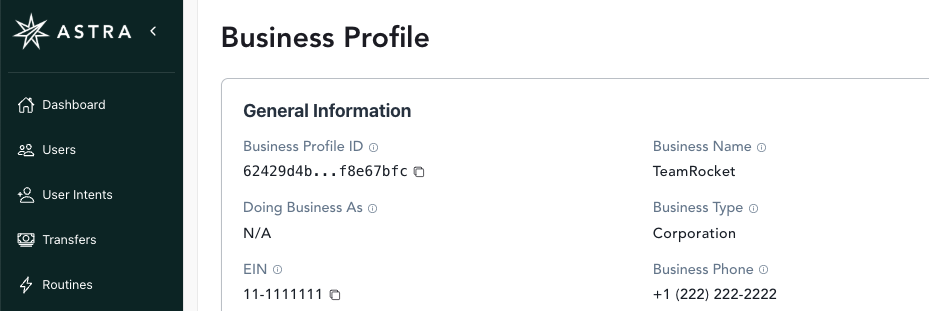
The Astra dashboard Business Profile is pictured above
Step 2: Set up your funding source
Choose one of these options. The account you set up here is the source.id in every routine request.
- Connect a corporate bank account. Register your business bank account to the Business User by using Create Account by Account and Routing Number.
Step 3: Onboard recipients and connect their cards
Each recipient needs a user profile, an authorization, and a connected debit card before you can send them a payout.
- Register the recipient by using Create UserIntent.
- Have the recipient authorize Astra and your application through the Astra SDK, or through the API with Create a Partner Identity Token.
- Collect the recipient's debit card. The SDK prompts the recipient to connect a card through Astra's PCI-compliant card form, or you can use your own card form.
- Get the card ID by using GET /v1/cards.
Step 4: Create the routine
Send the request with the Business User's access_token and an Idempotency-Key header in UUID format. We recommend UUID version 4. See this guide on why idempotent Routine creation is important.
curl --request POST \
  --url https://api-sandbox.astra.finance/v1/routines/account-to-card \
  --header 'Authorization: Bearer <BUSINESS_USER_ACCESS_TOKEN>' \
  --header 'Content-Type: application/json' \
  --header 'Idempotency-Key: 3f6c1b9e-8a2d-4c7e-9b1a-5d2e7f4a6c81' \
  --data '{
    "name": "Payout to Jane 12.99",
    "amount": 12.99,
    "settlement_mode": "net_debit",
    "source": { "id": "business_source_account_id" },
    "destination": {
      "id": "recipient_card_id",
      "user_id": "recipient_user_id"
    },
    "debit_fee_percent": 1.25
  }'
For Net Debit Mode:
destination.user_idis required.client_correlation_idis optional. If you don't send one, Astra generates an 8-character value.debit_fee_percentis a percentage, so1.25means 1.25%. With a subtracted fee, this request sends $12.83 to the card.
For every field, see Create an account to card routine.
To retry a request safely, reuse the same Idempotency-Key and resend the exact same request body. Astra returns the original routine instead of creating a duplicate. Use a new idempotency key for every new payout.
Response
A successful request returns 201 Created:
{
  "active": true,
  "amount": 12.99,
  "blocked": false,
  "created": "2026-10-28T23:11:40.646286+00:00",
  "debit_fee_percent": 1.25,
  "destination": {
    "id": "171ecae4-118e-4003-aa32-c0190ae35881",
    "user_id": "caaccb0495ff407cbca7920a6f82aa2e"
  },
  "id": "bf9452e0-3fc1-50aa-909b-76d5f82c895a",
  "name": "Payout to Jane 12.99",
  "payment_route": "account_to_card",
  "source": { "id": "astra_generic_bdba6aee8bc84be8b4100d050160727f" },
  "start_date": "2026-10-28",
  "status": "active",
  "type": "one-time"
}
A 201 means Astra accepted the routine, not that the payout succeeded. Use webhooks to get the result. For error responses, see Errors and Common Errors Responses.
Step 5: Track the payout
Step 5: Track the payout
Subscribe to these webhooks:
| Webhook | When Astra sends it |
|---|---|
transfer_created | Astra creates the transfer for the routine. |
transfer_updated | The transfer status changes, for example when the OCT succeeds or fails. |
routine_updated | The routine status changes, for example to completed or failed. |
Webhook payloads contain IDs, not statuses. When you get a transfer webhook, call GET /v1/transfers/{id} with the resource_id from the payload. Use the Business User's access_token. The recipient's token returns 404.
| Transfer status | Routine status | What it means |
|---|---|---|
pending | active | Astra created the transfer and is sending the OCT. |
processed | completed | The OCT succeeded, and the funds are on the recipient's card. |
failed | failed | The OCT failed. No funds moved, and the payout isn't included in the ACH debit. If an ACH debit fails, your corporate account will be automatically debited. |
For details on each leg, call GET /v1/transfers/{id}/segments. A successful payout has an oct segment with the amount the recipient received and a debit segment for this payout's share of your ACH debit.
Failed OCT
Failed OCT
If the card network declines the OCT, the transfer includes a failure_reason.
GET /v1/transfers/{id}:
{
  "id": "<transfer_id>",
  "routine_id": "bf9452e0-3fc1-50aa-909b-76d5f82c895a",
  "status": "failed",
  "failure_reason": "05 - Do not honor",
  "net_debit_batch_id": null
}
To try again, create a new routine with a new Idempotency-Key. Reusing the original key returns the failed routine. For what each code means and how to handle codes you don't recognize, see Debit Network Decline Codes.
Updated 6 days ago